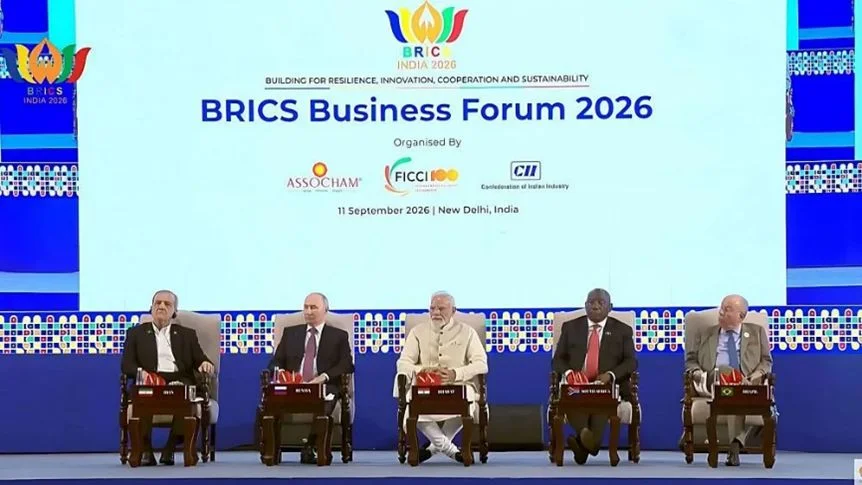
Iranian President Masoud Pezeshkian has called for stronger intra-BRICS trade, greater use of national currencies, expanded joint financing mechanisms, integrated trade infrastructure, and enhanced cooperation in the digital economy and reinsurance sector.
Addressing the BRICS Business Council, President Pezeshkian expressed his appreciation to the government and people of India for hosting the meeting and stressed the need to transform the economic potential of BRICS into practical cooperation and tangible projects.
The meeting brought together heads and representatives of BRICS member states, members of the BRICS Business Council, business leaders, investors, entrepreneurs and other economic stakeholders.
Referring to the increasingly complex global economic environment—including geopolitical uncertainty, disruptions to supply chains and the growing use of economic instruments to exert political pressure—Pezeshkian emphasized that the real strength of BRICS lies not merely in the size of its member economies, but in their ability to transform existing capacities into a network of trade, investment and joint financing.
Economic Resilience as a BRICS Priority
Pezeshkian stressed the importance of diversifying trade partners, financing sources and payment channels, describing economic resilience as a key requirement for the economies of BRICS member states.
Referring to Iran's experience of facing extensive sanctions and mounting economic and political pressures, he emphasized that economic security cannot be separated from national and regional security. Disruptions to trade, energy, infrastructure or financial systems can have consequences extending far beyond national borders.
Against this backdrop, Iran called for BRICS to develop resilient economic mechanisms capable of ensuring that no country can disrupt another country's legitimate trade by monopolizing a particular financial instrument or technology.
Iran's Proposal for Expanding Intra-BRICS Trade
Pezeshkian stressed the need to move from fragmented cooperation toward the gradual integration of trade infrastructure among BRICS members.
Iran proposed advancing the digitalization and integration of customs procedures, facilitating trade, reducing regulatory and administrative barriers, developing cross-border markets and facilitating joint private-sector investment as key measures to expand trade among BRICS economies.
He also emphasized stronger cooperation on standardization, with the aim of transforming BRICS from a market primarily focused on the exchange of raw materials into a network of joint value chains and industrial production.
Iran Ready to Contribute to Energy, Food and Transport Supply Chains
Food and energy security were highlighted as two fundamental pillars of economic security.
Given its extensive energy resources and strategic geographic position, the Islamic Republic of Iran announced its readiness to play the role of a strategic BRICS partner in energy, food and transportation supply chains.
Promoting the Use of National Currencies
Another key element of Pezeshkian's remarks was the expansion of national-currency use in trade among BRICS members.
He proposed that the use of national currencies be accompanied by appropriate mechanisms for managing currency risks and facilitating reciprocal settlements. According to the proposal, the concentration of the international financial system around a limited number of currencies leaves economies more vulnerable to political shocks.
Strengthening the Role of the New Development Bank
Iran also emphasized the importance of strengthening the role of the New Development Bank (NDB) in financing development projects.
The bank, according to the proposal, could become a central engine for financing infrastructure and energy projects in member states through dedicated credit lines, local-currency financing and guarantee instruments designed to attract private-sector investment.
Proposal for a Joint BRICS Reinsurance Company
One of President Pezeshkian's most specific proposals was the establishment of a joint BRICS reinsurance company with an initial capital of US$10 billion.
The proposed mechanism would help cover the risks associated with major infrastructure and energy projects, thereby strengthening confidence and encouraging greater private-sector participation in joint projects among BRICS members.
BRICS and the Digital Economy: Focus on Artificial Intelligence
Pezeshkian also highlighted the fundamental changes emerging from the rapid development of artificial intelligence.
He stressed that BRICS should not merely remain a consumer of technology, but should play an active role in knowledge production, technological development and the formulation of digital-economy standards.
Strengthening cybersecurity and protecting critical infrastructure across member states were also identified as important areas for cooperation.
Turning the BRICS Business Council into an Executive Engine
The Islamic Republic of Iran further proposed transforming the BRICS Business Council from a primarily dialogue-oriented forum into an executive engine for economic cooperation among member states.
To achieve this objective, the Council's specialized working groups should establish concrete and measurable projects based on clear indicators, including the growth of intra-BRICS trade, the share of national currencies in trade and the volume of private-sector investment.
Iran as a Key Link in BRICS Economic Connectivity
Concluding his remarks, President Pezeshkian highlighted Iran's strategic geographic position and energy capabilities and expressed the country's readiness to serve as one of the important links connecting the BRICS economies.
He emphasized that BRICS can become a truly influential force in the global economy only when the results of its cooperation are visible in contracts, factories, ports, infrastructure and the economic lives of people across member states.
President Pezeshkian reaffirmed Iran's readiness to work with all BRICS members toward building a more open, resilient and equitable global economy.