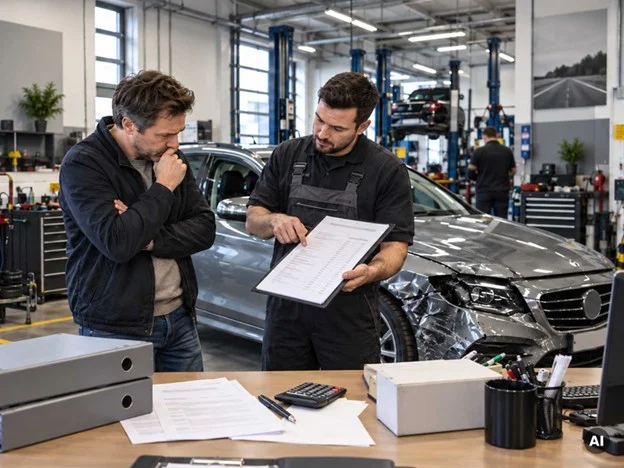
BGH: The Policyholder Bears the Repair-Shop Risk
- The ruling confirms the legal distinction between comprehensive insurance claims and third-party liability claims.
- The AvD recommends obtaining the insurer’s approval for repair costs before the repair work begins.
If a driver causes an accident and wishes to have the damage to their own vehicle covered under comprehensive insurance (Vollkaskoversicherung), they should pay particular attention to the scope of the proposed repairs and the costs estimated by the repair shop before authorizing the work.
In its ruling of 9 September 2026, the German Federal Court of Justice clarified that, in principle, the policyholder bears what is known as the “repair-shop risk” (Werkstattrisiko) in comprehensive insurance claims.
This means that the insurer is not necessarily required to cover excessive costs, objectively unnecessary repairs, or charges for work that was not actually carried out, unless such costs qualify as necessary expenses under the terms and conditions of the insurance policy.
The German Automobile Club (AvD) has explained the implications of the ruling and issued practical advice for consumers.
First, Determine How the Damage Occurred
The applicable insurance coverage depends on how the vehicle was damaged. There are essentially three situations:
- If another driver caused the accident, the at-fault driver’s motor liability insurance is generally responsible for compensating the damage.
- If the vehicle is damaged by events such as hail or theft, partial comprehensive insurance (Teilkaskoversicherung) may cover the loss, provided the relevant coverage is included in the policy.
- If the driver caused the accident themselves, comprehensive insurance (Vollkaskoversicherung) may cover the damage to their own vehicle.
It is in the third situation that the issue of the repair-shop risk, addressed by the BGH, becomes particularly relevant.
According to the ruling, when the policyholder is responsible for the accident, the comprehensive insurer is generally required to reimburse only those repair costs that are actually necessary and economically justified to restore the vehicle following the accident.
Accordingly, if the vehicle owner authorizes additional work or accepts excessive hourly labor rates, they may ultimately have to pay those additional costs themselves.
The At-Fault Policyholder Bears the Repair-Shop Risk
For this reason, drivers dealing with a comprehensive insurance claim resulting from an accident they caused should carefully review the proposed repairs and costs before authorizing the repair work.
The AvD recommends first obtaining a written repair estimate (Kostenvoranschlag) and submitting it to the insurer. The repair should then be authorized only after the insurer has confirmed the applicable coverage and costs.
Any subsequent changes to the scope of the repairs or additional work should also be discussed with the insurer and properly documented.
This can help prevent the vehicle owner from being left with unexpected costs that the insurer subsequently refuses to reimburse.
The Situation Is Different When You Are Not at Fault
The legal position is different when the accident was caused by another driver.
According to established BGH case law, the at-fault driver or their motor liability insurer generally bears the repair-shop risk as part of their legal obligation to compensate the injured party.
The BGH clarified this principle further in several decisions issued on 16 January 2024.
Under this case law, repair costs may, in principle, also be recoverable where the injured party could not reasonably have recognized that the costs resulted from defective, inappropriate, or economically inefficient repair work.
Key Takeaway
The first step is therefore to establish who caused the damage and which insurance coverage applies.
Where another driver is at fault, the claim should generally be pursued against the other driver’s motor liability insurer.
Where the policyholder intends to rely on their own comprehensive insurance, it is advisable to agree on the repair scope and estimated costs with the insurer before authorizing the repairs.